



In many conversations I have with procurement leaders in food & beverage, the same frustration keeps surfacing.
It’s not that teams lack market data. Most organizations track indices, follow commodity curves, and report on spend regularly. The real challenge is understanding how those market movements translate into actual cost and margin impact - early enough to do something about it.
Markets move faster than planning cycles. Cost drivers shift across materials and suppliers. And too often, procurement is asked to explain numbers after budgets are already affected, instead of guiding decisions before margins are under pressure.
This is where procurement’s strategic role is either unlocked or constrained.
The anonymized case below, from a global frozen food manufacturer, shows what changes when material price forecasting intelligence is used not as a reporting layer, but as a decision tool.
The Challenge: Managing Complexity in Packaging Procurement
Operating across multiple production facilities worldwide, this frozen food manufacturer manages relationships with numerous packaging suppliers while navigating volatile commodity markets. Their procurement team faced several critical challenges:
- Limited market visibility: Without real-time market benchmarks, the team struggled to validate whether negotiated prices represented true value
- Fragmented supplier performance data: Performance varied significantly across suppliers, but identifying optimization opportunities remained manual and time-consuming
- Reactive decision-making: Price negotiations relied on historical data rather than predictive insights, limiting the team's ability to capitalize on market movements
The company needed a solution that could transform their vast procurement data into actionable intelligence, enabling proactive decision-making and continuous performance improvement.
The Solution: Digital Twin Technology for Procurement Excellence
Predikt deployed its proprietary cost modeling platform to create a "digital twin" of the company's packaging procurement operations. This AI-powered solution provided:
Real-Time Market Intelligence
The platform continuously analyzed market conditions for various packaging materials, from standard corrugated boxes to specialized frozen food packaging. By establishing dynamic market price benchmarks, procurement managers could instantly assess whether their negotiated prices outperformed or lagged the market.
Supplier Performance Analytics
For the first time, the procurement team gained granular visibility into supplier-specific performance metrics. The system tracked actual paid prices against market benchmarks for each supplier relationship, revealing hidden patterns and opportunities.
Predictive Scenario Planning
Beyond historical analysis, Predikt's platform enabled forward-looking scenario planning, allowing the team to model different procurement strategies and their potential impact on costs.
The Results: Measurable Impact Across the Supply Chain
1. Validated Savings Against Market
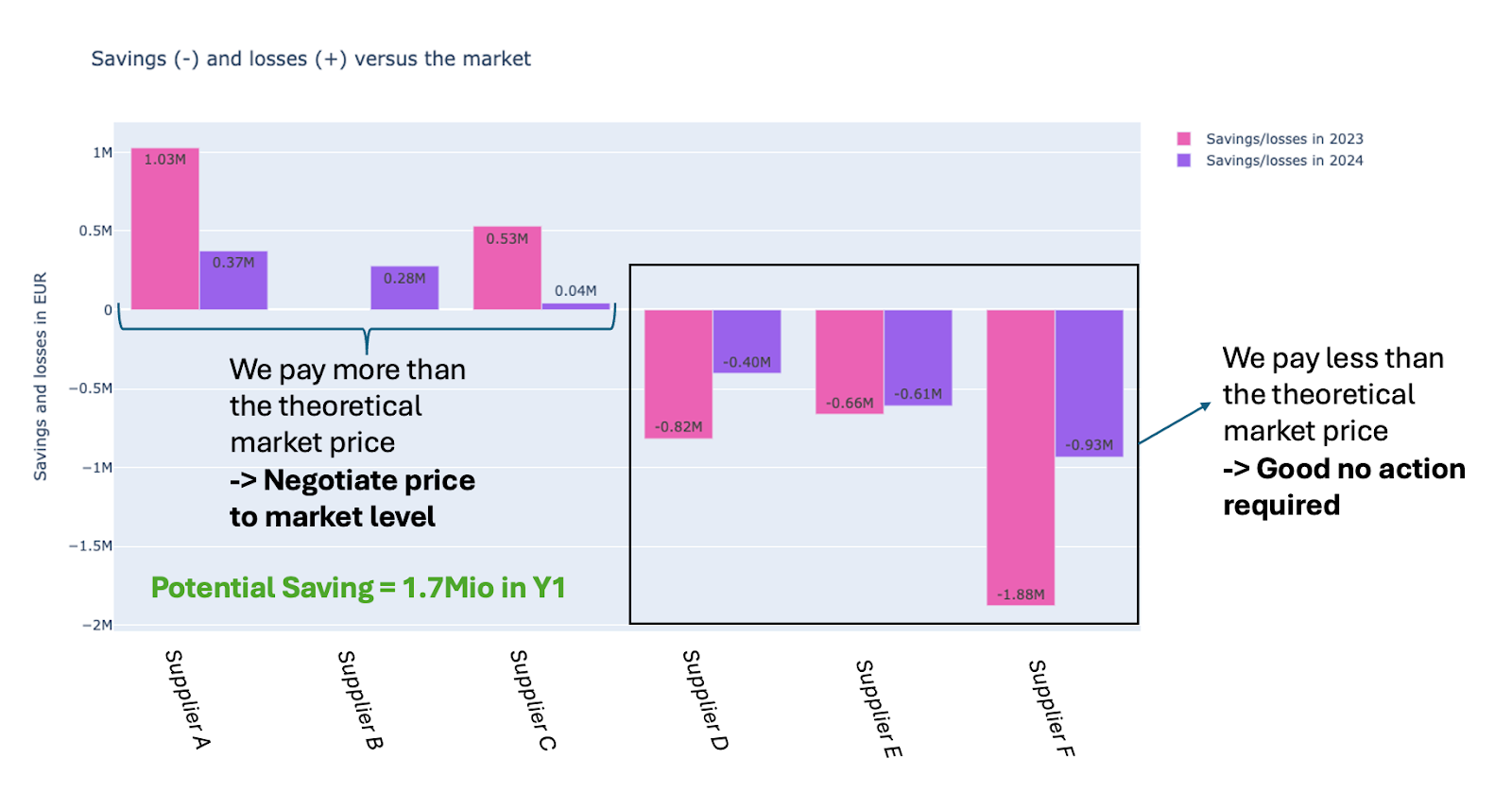
The implementation revealed impressive procurement performance:
- Year 1: €1.79 million in documented savings versus market prices
- Year 2: €1.25 million in continued savings, with improved buying strategies for previously underperforming suppliers
2. Supplier-Specific Insights Drive Strategic Action
The analysis uncovered significant performance variations across the supplier base:
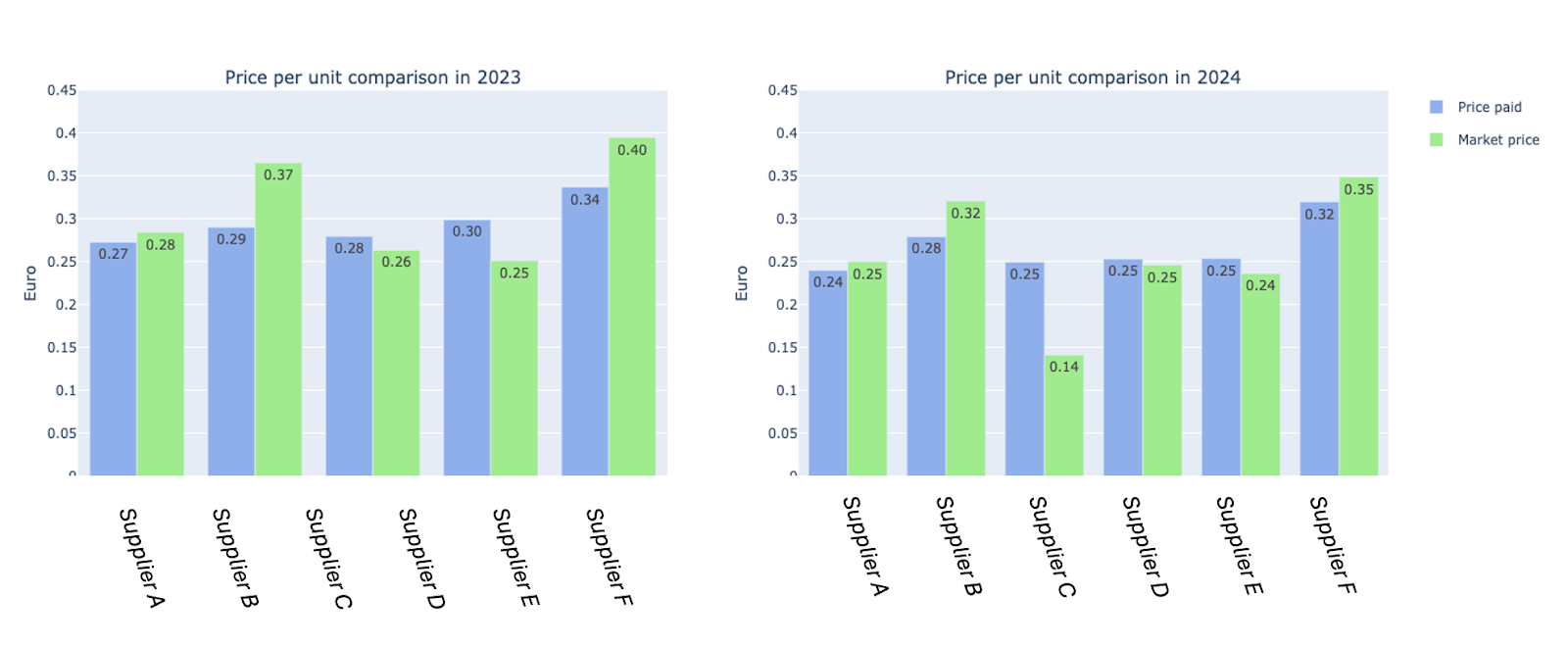
Top Performers: Several key suppliers consistently delivered prices 12-15% below market benchmarks. For one major European packaging supplier, the company achieved a remarkable 15% cost advantage, paying €0.34 per unit against a market price of €0.40.
Optimization Opportunities: The platform identified specific suppliers where market prices suggested potential for improvement. Armed with this data, the procurement team successfully renegotiated contracts, reducing year-over-year losses with these suppliers by up to 40%.
Strategic Wins: The company's largest packaging supplier delivered cumulative savings of €1.88 million over the two-year period, validating the strength of this strategic partnership.
3. Enhanced Procurement Strategy
The insights gained through Predikt's platform enabled the procurement team to:
- Prioritize negotiations based on data-driven opportunity sizing
- Validate supplier claims with objective market benchmarks
- Demonstrate value to internal stakeholders with quantifiable savings metrics
- Shift from reactive to predictive procurement strategies
Key Success Factors
1. Data-Driven Decision Making
By replacing intuition with intelligence, the procurement team could make faster, more confident decisions backed by real-time market data.
2. Continuous Improvement Culture
The platform's ongoing performance tracking created a feedback loop, enabling the team to continuously refine their strategies and capture emerging opportunities.
3. Supplier Relationship Optimization
Rather than applying blanket strategies, the team could tailor their approach to each supplier based on performance data, strengthening partnerships while improving commercial terms.
Looking Forward: Scaling Success
Building on these initial successes, the company is now expanding Predikt's deployment to additional spend categories and exploring advanced features including:
- Multi-scenario planning for volatile commodity markets
- Automated alerting for market opportunities
- Integration with existing procurement systems for seamless workflow optimization
Why this matters now
Volatility in food & beverage is no longer cyclical - it’s structural. In that context, material price forecasting is not about predicting exact prices. It’s about anticipating risk, understanding what drives cost movements, and making informed decisions with confidence.
The most advanced procurement teams are no longer asking what the market did yesterday. They are asking how external market movements connect to their internal cost structures and what actions will protect margins tomorrow.
That’s where procurement creates lasting value.



.png)
.png)