


I spent a decade as a master Anaplaner—one of the first in Europe, leading the Deloitte Alliance in Switzerland. I know the platform inside out. But even with that expertise, I kept running into the same problems during implementations. I knew there had to be a better way, especially for commodity-exposed procurement teams who needed intelligence to be dead simple to access. That belief is why I built Predikt. It’s not a knock on Anaplan—it’s great tech—but it addresses a different need for a different user.
Anaplan and Predikt are fundamentally not competitors. They operate in different categories, target different primary users, and solve distinct problems. What they share is an overlap in their user base, who often requires both tools. Understanding this clear distinction enables procurement and finance teams to make superior decisions—not just about selecting a tool, but about architecting a truly functional planning stack.
Different focus, different scope
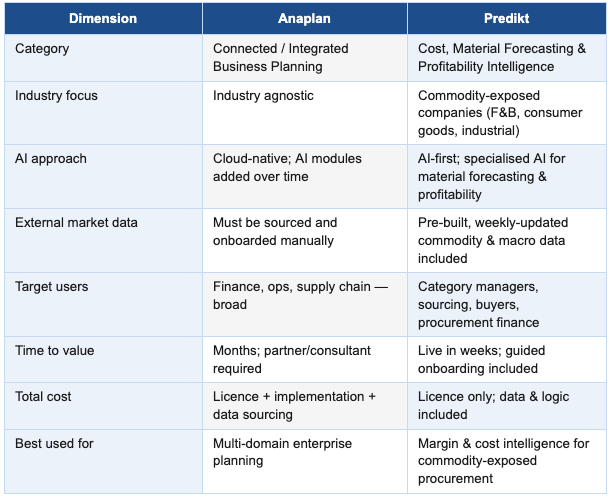
Anaplan is a connected planning platform — sometimes called integrated business planning. It is industry-agnostic and designed to serve many functions across an organisation: finance, sales, supply chain, HR. The idea is powerful: one environment where planning models across departments can be built, linked, and kept in sync. Predikt operates in a more specific category — cost intelligence, material forecasting, and profitability management for commodity-exposed companies. It does not try to span the enterprise. It goes very deep in one domain: helping procurement and finance teams understand and manage the cost and margin impact of commodity markets.
AI built for the use case, not added on top
Anaplan has evolved meaningfully in recent years and now offers AI capabilities embedded across its modules. These are genuine additions to a platform that was originally designed as a flexible modelling environment. Predikt is built the other way around: AI is not a feature layer, it is the foundation. The models are trained specifically on the problem of material cost forecasting and profitability intelligence for commodity-exposed businesses. In practice, this means Predikt will surface signals, patterns, and recommendations that a general-purpose AI layer cannot — because every part of it was built for this one domain.
External market data, already inside the platform
Commodity-exposed companies all work with the same set of external signals: commodity price indexes from price reporting agencies, local energy prices, labour cost indices, CPI, inflation rates. In Anaplan, getting this data into your planning models means finding the source, negotiating access, writing a specialised API or ETL process, and maintaining it over time. I have done this work myself at Deloitte — it is slow, fragile, and needs to be rebuilt almost every time. Predikt includes a pre-built database of these market indicators, updated weekly, available to every customer from day one. The market is already inside the platform.
Implementation and total cost of ownership
Because Anaplan is a blank canvas, making it work for procurement requires building the logic from scratch — which means an implementation partner with both technical and domain expertise, a project measured in months, and ongoing maintenance as requirements change. The total cost picture includes the licence, the implementation, and typically separate data subscriptions on top. Predikt comes with the procurement logic pre-built. Most customers are live within weeks, not quarters, and the external data is included. For commodity-exposed teams with a focused use case, the cost of ownership difference is significant.
Purpose-built for procurement & finance teams
Anaplan offers flexible dashboarding and the ability to build almost any view — within its visual framework. For analysts and technically skilled users, this is a strength. For category managers, sourcing managers, and buyers who need to make fast decisions about commodity exposure, make-or-buy choices, and hedging scenarios, the configuration burden can get in the way. Predikt is designed specifically for these users. The workflows, outputs, and language of the platform match the way procurement and procurement finance teams actually work.
Complementary by design
Almost all of Predikt's current customers evaluated Anaplan, Pigment, Jedox, or similar tools before choosing Predikt. They were not looking to replace their enterprise planning platform. They were looking for something those platforms could not give them: a deeply specialised, AI-powered cost and margin intelligence layer at the core of what they do. The model that works in practice is straightforward — Predikt handles cost intelligence for procurement, and that intelligence feeds back into the broader planning cycles running in Anaplan or other enterprise tools: financial planning, commercial planning, S&OP. Predikt is not a replacement for a connected planning platform. It is the specialised layer that makes the cost and margin inputs to those platforms far more accurate.
Side-by-side comparison
Want to see how Predikt fits your planning stack?
Get in touch at predikt.ai — we are happy to walk through a use case that matches your commodity exposure and planning environment.






.png)
.png)